
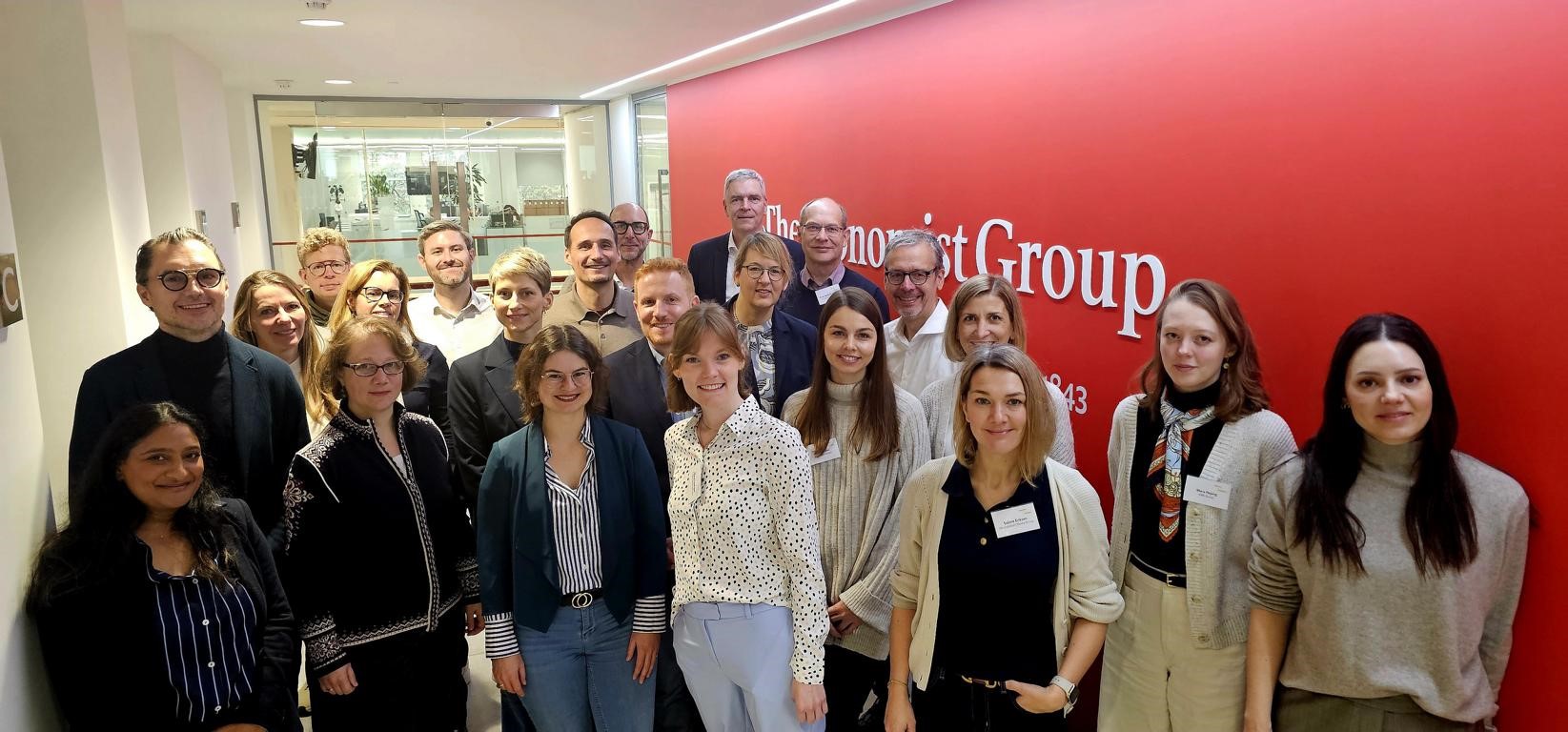
I recently had the opportunity to attend my second Subscription Tour – following a highly insightful event in Berlin in March 2024 – this time in my beloved London. It continues to be a genuinely inspiring experience, connecting with peers and experts in the subscription economy and very well organized by Yvonne, Stephanie (both from Verein Deutsche Fachpresse) and Lennart🙏✌️
This year’s London tour provided an exclusive look behind the scenes at some of the industry’s most innovative players, including The Economist, FT Strategies, Business Insider, B2B Marketing Propolis, Haymarket and Flo Health. The following is an excerpt of my favourite presentations.
Atlas
 Quelle: Lennart Schneider
The tour started on Wednesday, 12 November at lunch near Covent Garden with two presentations. One of them was the packed with best practices and holistic presentation about the subscription business by Abi Spooner from Atlas, a consultancy focused on recurring revenue strategies. The session, titled „How to make more money from subscribers,“ provided observations relevant to the publishing sector and businesses operating with subscription models. Atlas, which counts prominent names like The Guardian or The Economist among its clients, showcased a deep understanding of the market.
It was alos good to see that Abi refers to Robbie Kellman Baxter, who is also for me one crucial author, consiultat and podcast host in this business.
Atlas’s approach emphasizes data-driven solutions and an understanding of financial metrics, including ROI and customer lifetime value (LTV). A central tenet of their presentation was that while executing subscription strategies can be complex, success is attainable through a customer-centric approach and an awareness of common operational deficiencies.
Strategies to take away:
- Avoid the common pitfalls: work to build a relationship not a
single sale - Be inspired by what the best subscription businesses do (Duolingo, etc.)
- Put your customer at the centre of your strategy
- Subscriptions is a team sport – engage the whole team
- Know and monitor the metrics that matter; know your LTVs
Flo Health

On the second day we visited Flow Health in their remarkable modern office space in East London. Dmitry Gurski, CEO & co-founder, provided us with insights.
Flo Health’s journey illuminates key strategic imperatives crucial for any subscription business, especially those operating in sensitive or deeply personal domains:
- Trust-First Approach: For Flo, user trust isn’t just a byproduct; it’s the foundation of their entire offering. This imperative suggests that for products dealing with personal data or well-being, transparency, data security, and ethical communication are non-negotiable drivers of long-term subscriber relationships.
- Freemium Excellence for Global Reach: Flo’s success demonstrates the power of a well-executed freemium model to attract a vast global audience (420M+ users) while effectively converting a significant portion (3.4M+ Premium members) to subscribers. This balance between broad accessibility and premium value is vital for scaling.
- Personalization as a Premium Driver: Flo’s Premium features, like the virtual health assistant and personalized reports, highlight how deeply tailored, intelligent services can be a primary motivator for subscription. In a world of generic apps, personalization differentiates and proves tangible value.
Flo Health’s approach offers a compelling blueprint for how to build a global subscription business by prioritizing user trust, expertly balancing free and premium offerings, and delivering highly personalized value that resonates deeply with its audience.
The Audiencers
 Quelle: Lennart Schneider
The Tour continued its deep dive into cutting-edge strategies, and a particularly thought-provoking session came from Madeleine White, Co-founder and Editor-in-Chief of The Audiencers. As a B2B publication renowned for gathering and sharing insights from international publishers, The Audiencers (via their blog, vibrant WhatsApp community, and events) are at the forefront of understanding sustainable business models in digital publishing. Madeleine’s extensive expertise and deep network within the industry make her a formidable voice on the challenges and opportunities media brands face.
Her presentation, centered on the concept of „Funnel 2.0“, challenged the traditional, linear approach to the subscription journey, particularly in an era increasingly influenced by Artificial Intelligence.
Here is the key takeaways from Madeleine White’s compelling session:
The traditional marketing funnel (Awareness -> Interest -> Conversion -> Retention) is no longer sufficient. The Audiencers propose a „Funnel 2.0“, which fundamentally inverts this structure, placing Retention at the top, followed by Conversion, Interest, and Awareness.
This inverted funnel is driven by defining the „high revenue reader“ first. By understanding the characteristics and behaviors of these most valuable retained readers, publishers can then work backward through the funnel to find more individuals who exhibit similar potential.
FT Strategies
 Quelle: Lennart Schneider
Afterwards we visited FT Strategies. As a consultancy born from the venerable Financial Times, FT Strategies brings unparalleled practical experience in journalism, publishing, and media to the table, advising media organizations on strategic, commercial, and technological challenges.
Their session focused on the critical role of data and metrics in understanding the customer journey and driving sustainable subscription growth. What truly stood out was the emphasis on a rather unusual, yet profoundly impactful, role within their structure: Mike Migliore, the Pricing and Proposition Expert. It’s not every day you encounter someone with such a specialized focus, and his insights mastering how to monetize value.
Let’s dive into the core takeaways from FT Strategies‘ presentation, with a spotlight on Mike’s expertise:
- Granular Value Articulation: How to break down the perceived value of a subscription into tangible components that resonate with different customer segments. This involves understanding what specific features, types of content, or access privileges drive willingness to pay.
- Dynamic Pricing Strategies: Beyond simple tiers (as seen in earlier discussions), Mike’s expertise would delve into more nuanced pricing tactics. This could include personalized offers, behavioral pricing based on engagement, or the strategic use of bundles and add-ons to capture more value from diverse user groups.
- Proposition Design: It’s not just about the price, but the „what“ and „how“ of the offering. Mike’s role ensures that the features, benefits, and overall package align perfectly with the target audience’s needs and perceived value, effectively justifying the price point.
- The Interplay of Price and Retention: A true pricing expert understands that an optimal price point isn’t just about initial acquisition, but also about minimizing churn and maximizing CLTV. This involves continuous monitoring and adjustment based on retention data.
- Leveraging Data for Pricing Power: Mike’s insights would demonstrate how FT Strategies uses advanced analytics to understand price sensitivity, demand elasticity, and the impact of pricing changes on subscriber behavior. This data-driven approach allows for precise adjustments that optimize both volume and revenue.
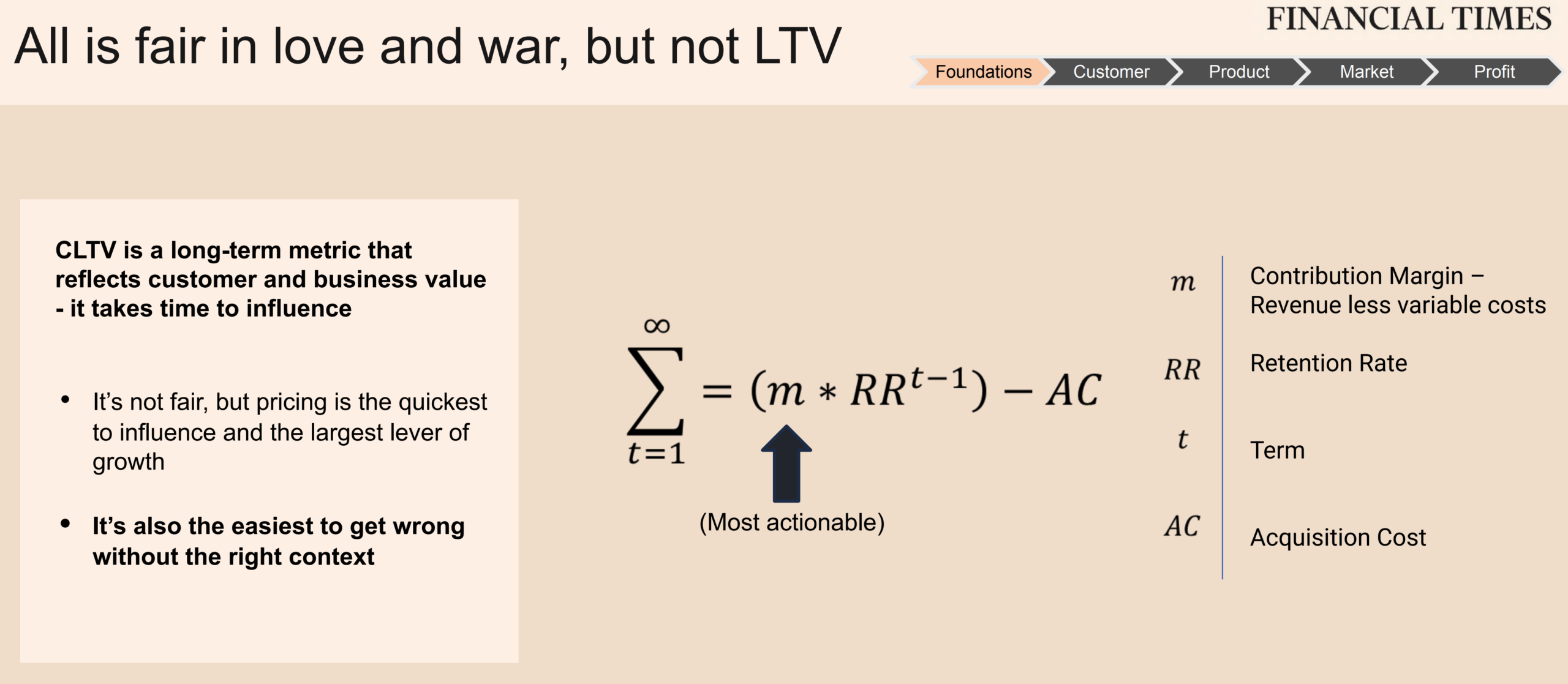
Mike also has a clear opinion about the one and only formula of the Customer Life Time Value (CLTV) as you can see in the slide below. He was crystal clrea that you always have to subtract the Customer Aquisition Costs.
Conclusion
Reflecting on the various presentations, several core insights have solidified for me and my smart home playing field:
- Publishing Industry Leads the Way: The publishing industry, more than many others, has truly embraced and mastered the intricacies of running subscription businesses effectively. Their journey provides an invaluable blueprint for any sector relying on recurring revenue.
- CLTV is the Ultimate Metric: This tour consistently reinforced that Customer Lifetime Value (CLTV) is the singular metric to strive for. It encapsulates the long-term health and profitability of a subscription business, shifting focus from mere acquisition to sustained value creation.
- Continuous BI Analysis is Fundamental: Objective, data-driven product decisions are impossible without continuous Business Intelligence (BI) analysis. This is the bedrock for understanding performance and making informed strategic adjustments.
- Continuous User Research is Key: To truly understand context, user needs, and customer satisfaction, ongoing user research is indispensable. It ensures that product development and feature enhancements are always aligned with what the audience truly values.
- Continuous Experiments (A/B Tests) are Mandatory: As demonstrated by companies like Strava and the insights from FT Strategies‘ pricing expertise, A/B tests are crucial not only for optimizing the conversion funnel but also for refining pricing strategies. This iterative approach is vital for maximizing both acquisition and profitability.
- Increase App Engagement to Foster Subscription Awareness: High engagement within the product (especially mobile apps) is a powerful driver for fostering awareness and perceived value of subscription offerings. A highly engaged user is a more likely and more loyal subscriber.
This Year’s Subscription Tour for me was a blast and has been a powerful reminder that while the tools and technologies evolve, the core principles of understanding your customer, measuring everything, and relentlessly optimizing the value exchange remain timeless.
Bildquellen
- K1024_10-DSCF7731: Lennart Schneider
- K1024_77-DSCF8161: Lennart Schneider
- K1024_64-DSCF8078: Lennart Schneider
- K1024_96-1000140809: Lennart Schneider
Schreibe einen Kommentar